

How I Stopped Renting My Digital Life and Started Owning It
The subscriptions weren't just costing me money. They were costing me control.
The Problem
I spend my days at work finding ways to cut costs and increase margins. It is literally my job. I have done it for companies for years.
At some point I started reading about financial independence. The Simple Path to Wealth. The idea that the gap between what you earn and what you spend is the only number that actually matters. That every dollar you stop sending to someone else is a dollar working for you instead.
So I did what I do at work. I opened a spreadsheet and actually looked at where my money was going.
The subscriptions line stopped me cold.
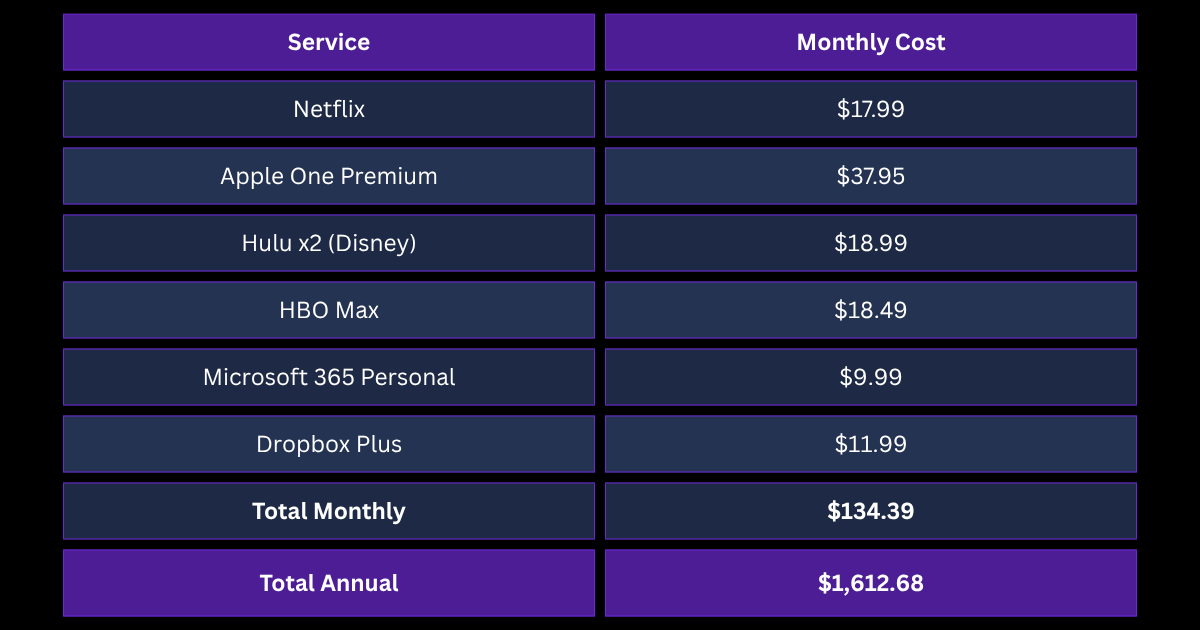
Not one big number. A hundred small ones. $17.99 here. $37.95 there. $9.99 for something I used twice a month. Each one felt reasonable on its own. Together they were bleeding me out slowly and I had just never looked at the total.
Over $130 a month. Over $1,600 a year. Gone. Automatically. To companies that would raise prices next year and the year after that, quietly, counting on me not to notice.
I noticed.
The Math Does Not Lie
Corporations will tell you price increases are necessary. Rising costs. Inflation. The cost of doing business.
Fine. Let’s use their logic.
If Netflix had only raised prices in line with inflation, their standard plan would cost $11.93 today. Not $17.99.
That $6.06 difference per month does not sound like much. That is $72.72 a year. On one service. Multiply that across every subscription you pay for and you start to see what is actually happening.
Now consider this. The median American household earned $57,739 in 2010. Today that same household earns around $76,550. That is 33% increase in income over 16 years.
Netflix raised their prices 125% over the same period.
Your paycheck went up by a third. Their price went up by more than double. And Netflix is just one subscription. Every service on your monthly statement is running the same playbook. Raise prices faster than wages. Count on inertia to keep you subscribed. Repeat every year.
The math was never in your favor.
What I Tried First
The obvious move was to cancel.
So I did. Went through everything, cut what I could, downgraded what I couldn’t. Dropped the premium tiers. Switched to ad supported plans. Told myself the ads were fine.
They were not fine.
Then came the bundling phase. If I drop Netflix maybe I pick up something cheaper. Sling TV was around. There were bundles to get this streaming service and that one together for a deal. I spent more time researching alternatives than I care to admit, bouncing from one service to another trying to find the right combination that cost less but gave me everything I wanted.
It never worked out that way.
Drop one, pick up another. Downgrade one, upgrade something else. The total number barely moved. And the ads. The constant ads on the cheaper tiers made me realize these companies had figured out how to charge me twice. Once with my money and once with my attention.
The problem was not which subscriptions I had. The problem was that I was still playing their game.
Swapping one corporation for another was not the answer. Getting off the board entirely was.
The Turning Point
Like a lot of you, I bought into the cut the cord movement back when it started. Saved my family over a hundred dollars a month ditching cable. It felt like winning.
But capitalism did what capitalism does. More companies saw the opportunity and jumped in. Netflix. Hulu. Disney. Max. Peacock. Apple TV. Before long we were right back to spending the same or more than we ever did on cable.
We traded one problem for the same problem with a different logo.
I was already deep in the financial independence mindset at this point. Reading everything I could about reducing expenses, increasing the gap between what I earned and what I spent. And I kept coming back to the same question; why am I paying monthly for access to things that could just live on my own hardware?
I started digging.
Turns out there is an entire world of free, open source software built specifically to replace the tools we pay corporations for every month. Photo libraries. Media servers. Budget apps. Password managers. All of it. Running on hardware you own. Answering to nobody.
That was the moment everything changed.
What I Did Differently
I started where most people start. Media.
Plex was the first thing I set up. The idea was simple: take everything I owned, DVDs, digital purchases scattered across platforms, convert them to a format I could store and stream myself, and stop paying for the privilege of watching content I already owned.
Media was actually the easy part.
Finding a home for my family photos was a different story entirely.
I tried Nextcloud first. It worked, sort of, but never the way I actually wanted it to. Photo management felt clunky. Sharing was frustrating. But I had committed and made the mistake of enabling Nextcloud’s encryption on my photo library.
Then Nextcloud stopped loading.
150,000 family photos. Encrypted. Locked behind a service I could not get back into.
I spent days tracking down a bash script that could decrypt the files using the encryption keys I had saved. Luckily I had those keys. Luckily the script existed. Luckily it worked. But that experience taught me something I have never forgotten: encryption without a clear recovery path is just a more stressful way to lose your data. And always backup your data in multiple places, especially the critical stuff.
I tried other photo platforms after that. None of them felt right. Too slow, too limited, too clunky. For years my photos were in a kind of limbo, technically safe, never quite where I wanted them and thus just lived on Apple’s servers.
Meanwhile the media server kept growing. Plex. Tautulli for monitoring. The hardware kept evolving too. Started on a Raspberry Pi, not enough power. Moved to a Synology NAS, still not enough power. Eventually built my own machine with a cheap GPU that could handle transcoding and external streaming. Got everything stable on Unraid and ran it that way for a long time.
Then an update broke something. Or I broke something moving app data, honestly still not sure which. Could not load the Unraid UI without going into recovery mode. Spent hours trying to fix it. Could not. Made peace with it, confirmed my data was safe on the drives, and rebuilt everything from scratch on Fedora Server.
This time with Docker Compose for everything. This time without encrypting my data at the filesystem level. This time with proper backups.
Right before my Unraid server failed, I found Immich.
It was the photo management solution I had been looking for the entire time. Fast. Beautiful. Face recognition. Mobile app that actually works. I had actually been running it on Unraid before everything broke, so when I rebuilt I restored from my Immich backups, spun up a new Docker Compose file, and it came back exactly as it was. Which I will not lie, was a shock to me.
150,000 photos. Home. Finally.
After that the stack grew from the first two to many more items over time:
Media streaming: Plex (would consider Jellyfin for new setups, fully open source unlike Plex, but Plex still is easier and has a nice mobile app)
Photos: Immich - see their demo site to understand why I stayed
Budget: Actual Budget replacing YNAB
Passwords: Vaultwarden
File storage: my own SMB share
Tailscale: for accessing my data outside my home
One by one. On hardware I own. Answering to nobody.
It took years of tinkering. Breaking things. Rebuilding. Learning. I am still learning.
That is the part the polished tutorials leave out. Self-hosting is not a one afternoon project. It is a practice. It can be a rabbit hole. And every time something breaks you understand the whole system a little better than you did before. But I would not go back. Knowing what I know now, and having found the self-hosting community along the way, there is no version of me that returns to renting my digital life.
Where I Am Now
My server runs 24 hours a day, 7 days a week, in my home. Fedora Server. Docker Compose. Stable. The same stack I rebuilt from scratch after Unraid broke, now running better than it ever did on Unraid. I have nothing against Unraid it was great and served me well, but I am happier with my current setup.
My photos are home. All 150,000+ of them. No longer hostage to Apple’s servers or locked behind a broken Nextcloud encryption nightmare. Just sitting on drives I own, backed up properly, accessible from anywhere through Tailscale without a single port open to the outside world. And best of all, the Immich mobile app automatically switches to my Tailscale IP address when I leave home, so my photos are always with me. I have automatic backups setup so anytime a new photo hits my photo library on my iPhone it backs up to my home server.
My media plays when I want it. My budget is mine. My passwords live on my hardware. My files sync across devices without touching a corporate server.
Monthly cost for all of it: electricity. About $12 a month.
No subscription renewals. No price increase emails. No terms of service updates I have to pretend to read. No corporation deciding what features I get to keep. No one mining my family photos to train their AI model. No one storing my financial data on a server I have never seen.
I am not going to pretend the road here was clean. You just read the story. Nextcloud encryption nightmares. Hardware that was not powerful enough. An Unraid server I could not recover. Years of tinkering, breaking things, and rebuilding from scratch.
But I would do all of it again without hesitation.
Because the alternative is what we started with. Over $130 a month. Over $1,600 a year. Growing every year. For access to things that should already be mine.
That is why I started Your Data, Your Rules.
I am not an expert with a course to sell you. I am someone who figured it out the hard way and thought other people might benefit from watching me do it again, more carefully this time, and writing it all down.
Every issue I will show you one piece of this stack. What it replaces. Why it is worth it. And exactly how to set it up yourself.
Your data. Your hardware. Your rules.
What This Costs You To Start
You do not need expensive hardware. You do not need to be a developer. You need a spare computer, a Raspberry Pi, or a Virtual Machine, an internet connection, and a few hours on Sundays.
One time hardware investment of $0 to $150 if you do not already have something lying around. A few dollars a month in electricity. That is your entire cost structure.
Think about that for a second. One month of the subscriptions you just saw above could buy the hardware to replace most of them permanently. One month. And every month after that you keep the money. Or reinvest into your home server.
The corporations spent years making you believe there was no alternative. There is. It just requires your time and the willingness to try something different.
What Is Coming Next
I am going to walk you through exactly how I set this up from scratch. No experience needed.
What is self-hosting and why should you care
Setting up Linux on any hardware
Docker and Docker Compose, the engine that runs everything
Your first replacement, ditching streaming services for Plex or Jellyfin
You do not need to be technical. You need to be tired enough to try something different and willing to learn.
Corporations count on you not noticing the incremental increases. I am here to help you notice.
Let us take back control.
Your Data, Your Rules publishes every two weeks. Free subscribers get every post. Paid subscribers get the detailed step-by-step setup guides and docker configs.
Affiliate Disclosure This post contains affiliate links to products I personally use or would recommend. If you purchase through these links I may earn a small commission at no extra cost to you. I only recommend hardware and material I would buy myself.